
Article Plan: Basketball Pre-Game Warm-Up Routine (PDF Focus)
This article details constructing effective basketball warm-ups, referencing narrative literature reviews and PDF resources like FIBA guidelines and Special Olympics Nevada guides.
Basketball warm-ups are a crucial, often underestimated, component of game preparation. They aren’t merely about breaking a sweat; a well-structured routine primes athletes physically and mentally for the demands of the game. Investigations explore constructing functional warm-ups, often documented in readily accessible PDF formats.
These routines typically blend light cardio with dynamic stretching, progressively increasing intensity. Resources like those from FIBA and Special Olympics Nevada offer detailed guides. Understanding the ‘why’ behind each exercise – increasing core temperature, enhancing muscle elasticity, and improving reaction time – is paramount. Proper warm-ups significantly reduce injury risk and optimize performance, making PDF guides invaluable tools for coaches and players alike.
II. Importance of a Pre-Game Warm-Up
A comprehensive pre-game warm-up is paramount in basketball, directly impacting performance and injury prevention. Failing to adequately prepare muscles and cardiovascular systems increases susceptibility to strains, sprains, and more severe injuries. Numerous studies, often summarized in accessible PDF reports, highlight this correlation.
Warm-ups elevate muscle temperature, enhancing elasticity and nerve conduction velocity. They also improve joint range of motion and mental focus. Resources like FIBA guidelines emphasize the necessity of a progressive warm-up, mirroring game demands. Coaches utilize PDF-based routines to ensure consistency and effectiveness, ultimately maximizing player potential and minimizing risk.
III. Goals of a Basketball Warm-Up Routine
The primary goals of a basketball warm-up are multifaceted, extending beyond simple physical preparation. A well-structured routine, often detailed in PDF format for easy coach access, aims to increase core body temperature, elevating muscle readiness. Simultaneously, it enhances joint lubrication and range of motion, crucial for dynamic movements.
Furthermore, a good warm-up neurologically primes players, improving reaction time and coordination. Resources like the Special Olympics Nevada dynamic warm-up guide (available as a PDF) demonstrate this focus. Ultimately, the goal is to minimize injury risk and optimize performance, preparing athletes both physically and mentally for the demands of the game.
IV. Dynamic vs. Static Stretching in Basketball
Understanding the difference between dynamic and static stretching is vital for an effective basketball warm-up, often outlined in coaching PDFs. Dynamic stretching – controlled movements through a full range of motion – is favored before play, increasing blood flow and preparing muscles. Resources emphasize its role in mimicking game actions.
Conversely, static stretching – holding a stretch for a prolonged period – can temporarily decrease power and reaction time. While beneficial for cool-downs, its pre-game use is limited. PDF guides from organizations like FIBA often highlight this distinction, advocating for dynamic routines to optimize performance and reduce injury risk.
A. Benefits of Dynamic Stretching
Dynamic stretching offers numerous advantages for basketball players, frequently detailed in warm-up PDFs. It elevates muscle temperature, enhancing elasticity and reducing stiffness – crucial for explosive movements. These stretches improve range of motion, preparing joints for the demands of the game.
Furthermore, dynamic movements mimic basketball-specific actions, neurologically priming the body for play. PDF resources, like those from Special Olympics Nevada, showcase routines that increase heart rate and blood flow, delivering oxygen to working muscles. This proactive approach minimizes injury risk and optimizes athletic performance, as highlighted in various coaching materials.
B; Limitations of Static Stretching Before Play
While commonly practiced, static stretching before basketball activity presents limitations, often addressed in comprehensive warm-up PDF guides. Holding stretches for extended periods can temporarily decrease muscle power and explosiveness – vital for jumping, sprinting, and quick changes of direction.
Research, referenced in injury prevention resources (like those found at nisu.flinders.edu.au in PDF format), suggests static stretching doesn’t adequately prepare muscles for the dynamic demands of basketball. PDFs from organizations like FIBA emphasize prioritizing dynamic movements to enhance performance and reduce injury risk over prolonged static holds pre-game.
V. Components of a Comprehensive Warm-Up
A truly effective basketball warm-up, often detailed in PDF warm-up guides, isn’t just stretching; it’s a multi-phased process. It begins with light cardio – jogging or jumping jacks – for 5-10 minutes, increasing blood flow and core temperature.
Following cardio, a dedicated dynamic stretching phase (10-15 minutes) prepares muscles for specific movements. Many PDF resources, including those from Special Olympics Nevada, outline specific dynamic exercises. A complete warm-up, as highlighted in FIBA documentation, also incorporates basketball-specific drills to bridge the gap between general preparation and game readiness.
A. Light Cardio (5-10 Minutes)
The initial phase of any basketball warm-up, frequently outlined in PDF guides, centers around light cardio lasting 5-10 minutes. This isn’t about exhaustion; it’s about gradually elevating heart rate and increasing blood flow to the muscles.
Activities like jogging, jumping jacks, or high knees are common choices. These exercises increase core body temperature, preparing muscles for more intense activity. PDF resources often emphasize the importance of controlled movements during this phase, avoiding sudden stops or strenuous exertion, as detailed in injury prevention reports.
B. Dynamic Stretching (10-15 Minutes)
Following light cardio, dynamic stretching – a cornerstone of modern basketball warm-ups detailed in numerous PDF resources – should occupy 10-15 minutes. Unlike static stretching, dynamic movements actively prepare muscles for the demands of the game.
These stretches involve controlled, fluid motions that increase range of motion and muscle activation. PDF guides from organizations like FIBA and Special Olympics Nevada highlight the benefits of dynamic stretching for injury prevention and performance enhancement. This phase prepares the body for basketball-specific drills.
VI. Specific Dynamic Stretches for Basketball
Numerous PDF guides detail effective dynamic stretches for basketball. Leg swings (forward, backward, and sideways) improve hip mobility, crucial for agility. Arm circles (forward and backward) enhance shoulder range of motion for passing and shooting. Torso twists prepare the core for quick changes in direction.
These movements, often found within comprehensive warm-up routines outlined in resources like the Special Olympics Nevada Dynamic Warm-Up Guide (PDF), increase blood flow and prepare muscles. Implementing these stretches, as suggested by various PDFs, minimizes injury risk and optimizes performance.
A. Leg Swings (Forward, Backward, Sideways)

Leg swings are a foundational dynamic stretch, frequently detailed in basketball warm-up PDFs. Forward swings target hamstrings, backward swings focus on hip flexors, and sideways swings engage adductors and abductors. These movements increase hip mobility, vital for explosive movements on the court.
Many resources, including guides from organizations like FIBA (available as PDFs), recommend 10-15 repetitions per leg, per direction. Proper form—controlled movements, maintaining balance—is emphasized in these PDFs to prevent injury and maximize effectiveness during pre-game preparation.
B. Arm Circles (Forward, Backward)
Arm circles, a staple in basketball warm-up routines outlined in numerous PDF guides, enhance shoulder mobility and prepare the upper body for shooting and passing. Forward circles focus on anterior deltoids, while backward circles target posterior deltoids, promoting balanced muscle activation.
PDF resources from organizations like Special Olympics Nevada often recommend starting with small circles and gradually increasing the diameter. Performing 15-20 repetitions in each direction is common. These exercises, detailed in warm-up PDFs, improve range of motion and reduce the risk of shoulder injuries during gameplay.
C. Torso Twists
Torso twists are a crucial component of dynamic warm-ups for basketball, frequently detailed within PDF warm-up guides. These movements enhance spinal mobility and core engagement, vital for agility and efficient movement on the court. PDF resources emphasize controlled rotations, avoiding jerky motions to prevent injury.
Players can perform torso twists with or without a basketball, adding a slight resistance. Many PDFs suggest 15-20 repetitions, focusing on maintaining a stable core and proper posture. This exercise, often found in FIBA warm-up guidelines PDFs, prepares the body for the rotational demands of passing, shooting, and defensive movements.
VII. Basketball-Specific Drills in Warm-Ups
PDF resources consistently highlight the importance of integrating basketball-specific drills into pre-game warm-ups. These drills bridge the gap between general dynamic stretching and game-like intensity. Common drills include dribbling exercises focusing on various hand changes and speeds, often detailed in downloadable PDF guides. Passing drills – chest, bounce, and overhead – are also emphasized, preparing players for accurate ball movement.
Many PDFs, like those from Special Olympics Nevada, include “Basketball Warmup Games” such as “Dribble Freeze.” These drills, found within comprehensive warm-up PDFs, enhance reaction time and ball control, optimizing performance.

A. Dribbling Drills (Various Hand Changes & Speeds)
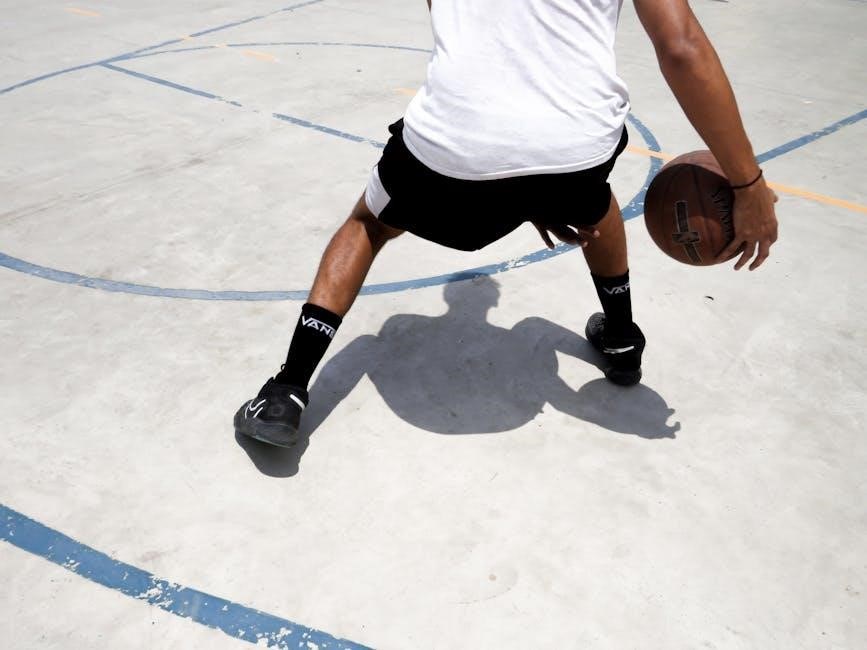
PDF warm-up guides frequently detail dribbling drills as foundational components. These drills emphasize rapid hand changes, accelerating and decelerating, and navigating obstacles – skills crucial for game situations. Many PDF resources suggest variations like cone dribbling, figure-eight patterns, and dribbling with a defender applying light pressure.
“Dribble Freeze,” mentioned in Special Olympics Nevada PDFs, exemplifies a drill enhancing ball control and reaction time. These drills, often visually demonstrated in PDFs, prepare players for the dynamic demands of a basketball game, improving agility and coordination.
B. Passing Drills (Chest Pass, Bounce Pass, Overhead Pass)
PDF-based basketball warm-up routines consistently incorporate passing drills to refine technique and build team cohesion. These drills cover fundamental passes – chest, bounce, and overhead – emphasizing accuracy and speed. Many PDF resources advocate for partner passing, progressing to passing while moving.
The aim, as outlined in various guides, is to activate passing muscles and improve communication. FIBA resources, often available as PDFs, highlight the importance of crisp, efficient passing. Drills detailed in these PDFs prepare players for quick ball movement during gameplay, enhancing offensive flow.
VIII. Shooting Warm-Up Progression
PDF shooting warm-up guides typically advocate a gradual progression, starting with form shooting at close range. This focuses on proper technique before adding distance. Many PDF resources detail drills emphasizing consistent release points and follow-through.
The progression then moves to incrementally increasing distance, often in stages – free throw line, short jumpers, then three-pointers. PDFs from organizations like FIBA often include shooting drills designed to simulate game situations. This prepares players for various shot types and distances encountered during a game, optimizing shooting performance.
A. Form Shooting (Close Range)
PDF warm-up guides consistently prioritize form shooting as the initial phase. This involves shooting from directly under the basket, focusing solely on proper technique. The aim, detailed in many PDF resources, is to establish a consistent shooting form – grip, elbow position, release, and follow-through.
Players typically begin with two-handed form shooting, then progress to one-handed drills. PDFs often suggest 10-15 repetitions at each stage. This close-range work builds muscle memory and reinforces correct mechanics before introducing the complexities of distance and game speed, as highlighted in FIBA resources.
B. Gradual Increase in Distance
PDF-based basketball warm-up plans emphasize a progressive approach to shooting distance. After establishing solid form at close range, players incrementally move further from the basket. This typically starts with short jumpers, then mid-range shots, and finally three-pointers.
Many PDF guides, including those from Special Olympics Nevada, recommend shooting 5-10 shots from each spot before moving further. This gradual increase allows players to maintain proper form while adapting to the increased physical demands. Resources like FIBA documents stress the importance of controlled progression to avoid fatigue and injury during the warm-up.
IX. Defensive Warm-Up Drills
PDF resources detailing basketball warm-ups consistently include defensive preparation. Drills focus on agility and reactive movements crucial for game readiness. Common exercises, often outlined in Special Olympics Nevada guides, involve shuffle steps and defensive slides to improve lateral quickness.
Reaction drills, designed to enhance responsiveness, are also prevalent. These may include reacting to a coach’s signal or mirroring an opponent’s movements. PDF plans from organizations like FIBA emphasize the importance of simulating game-like scenarios during defensive warm-ups, preparing players for various offensive attacks.
A. Shuffle Steps & Slides
PDF warm-up guides frequently prioritize shuffle steps and slides as foundational defensive movements. These drills, often detailed in resources like the Special Olympics Nevada Dynamic Warm-Up Guide, enhance lateral agility – vital for staying in front of opponents. Players practice maintaining a low defensive stance while quickly shuffling side-to-side.
Slides, a variation, involve a slightly longer stride, covering more ground. PDF materials emphasize proper form: keeping the back straight, knees bent, and hands active. These exercises, often performed across the width of the court, prepare muscles for the demands of defensive play, minimizing injury risk.
B. Reaction Drills
PDF-based basketball warm-up plans often incorporate reaction drills to sharpen defensive responsiveness. These drills, crucial for anticipating opponent movements, typically involve a coach or teammate providing verbal or visual cues. Players react by quickly shuffling, sliding, or sprinting in a designated direction.
Variations include reacting to hand signals or changes in ball position. Resources emphasize maintaining a low defensive stance and quick footwork throughout. These drills, detailed in various PDF guides, improve agility and decision-making under pressure, preparing players for game-like scenarios and enhancing overall defensive performance.
X. Core Activation Exercises
PDF warm-up resources consistently highlight the importance of core activation. A stable core is fundamental for efficient movement, power transfer, and injury prevention in basketball. Exercises often include planks (various modifications), side planks, and bird-dogs, focusing on engaging deep abdominal muscles.
Dynamic movements like Russian twists with or without a ball, and bicycle crunches are also common. These exercises, detailed in guides from organizations like FIBA, prepare the core for the demands of jumping, pivoting, and quick changes of direction. Proper core activation enhances athletic performance and reduces the risk of strain.
XI. Warm-Up Duration & Timing
PDF guides on basketball warm-ups generally recommend a total duration of 20-30 minutes. Timing is crucial; the warm-up should begin approximately 60-90 minutes before game time, allowing sufficient time for physiological preparation without fatigue. Light cardio and dynamic stretching typically occupy the first 15-20 minutes.
The final 10 minutes should focus on basketball-specific drills, progressively increasing intensity. FIBA resources emphasize adjusting duration based on player experience and environmental conditions. A well-timed warm-up maximizes performance and minimizes injury risk, as detailed in various downloadable plans.

XII. Individualization of Warm-Up Routines

PDF resources highlight the importance of tailoring warm-ups to individual player needs. Factors like injury history, position, and physical condition necessitate customized routines. Players with prior injuries may require additional pre-activation exercises, often detailed in specialized PDF guides.
Coaches should observe players during warm-ups, monitoring for signs of tightness or discomfort. Adjustments, such as extra stretching or modified drills, should be made accordingly. A one-size-fits-all approach is suboptimal; individualization maximizes effectiveness and minimizes injury potential, as emphasized by FIBA and Special Olympics Nevada.

XIII. Sample Basketball Pre-Game Warm-Up Routine (PDF Structure)
Many PDF resources, including those from FIBA and Special Olympics Nevada, present structured warm-up routines. A typical structure begins with 5-10 minutes of light cardio – jogging or jumping jacks. This transitions into 10-15 minutes of dynamic stretching, focusing on leg swings and torso twists.
Following stretching, basketball-specific drills – dribbling with hand changes, chest passes, and form shooting – are included. A progressive shooting warm-up, starting close to the basket and gradually increasing distance, concludes the routine. These PDF plans often detail timings and repetitions for each exercise.
XIV. Utilizing PDF Resources for Warm-Up Plans
PDF documents offer readily accessible, detailed basketball warm-up plans. Resources from organizations like FIBA provide internationally recognized guidelines, while Special Olympics Nevada offers adapted routines. These PDFs often include visual aids and specific exercise instructions, enhancing understanding and implementation.
Furthermore, research reports, available as PDFs (like those from Flinders University cited online), justify exercise choices for injury prevention. Coaches can download and customize these plans, tailoring them to their team’s needs. Utilizing PDFs ensures a structured, evidence-based approach to pre-game preparation.
XV. FIBA Warm-Up Guidelines
FIBA, the International Basketball Federation, provides comprehensive warm-up recommendations accessible through their official publications, often available as PDF downloads. These guidelines, current as of June 2020, emphasize a progressive approach, starting with light cardio and progressing to sport-specific movements.
FIBA’s resources detail the importance of dynamic stretching and activation exercises, focusing on preparing players for the demands of the game. Their materials, found at fiba.basketball, offer a standardized framework for coaches globally, promoting player safety and optimizing performance through structured warm-up routines.
XVI. Special Olympics Nevada Dynamic Warm-Up Guide
Special Olympics Nevada offers a detailed PDF guide focused on dynamic warm-ups specifically tailored for basketball athletes. This resource, designed to increase core temperature and engage basketball-specific muscles, prioritizes accessibility and inclusivity for athletes of all abilities.
The guide, available online, outlines a sequence of exercises – including leg swings, arm circles, and torso twists – to prepare players physically and mentally. It emphasizes a progressive approach, building intensity gradually. This PDF serves as a valuable tool for coaches seeking a structured and adaptable warm-up routine.
XVII. Injury Prevention Through Proper Warm-Up

Proper basketball warm-ups, often detailed in PDF resources, are crucial for injury prevention. A well-structured routine increases muscle temperature, improves flexibility, and enhances neuromuscular control, reducing the risk of strains, sprains, and other common basketball injuries.
Research, like that cited in reports from Flinders University (accessible via PDF links), highlights the link between targeted warm-up exercises and decreased injury rates. Dynamic stretching, a key component, prepares muscles for the demands of the game. Ignoring a thorough warm-up significantly elevates injury susceptibility.
XVIII. Monitoring Player Response During Warm-Up

PDF-based warm-up plans should emphasize observing player responses. Coaches must actively monitor athletes for signs of fatigue, discomfort, or limitations during the routine. Adjustments should be made based on individual needs and feedback – a standardized approach isn’t always optimal.
Pay attention to movement quality; compromised form indicates potential issues. Communication is key; encourage players to report any pain or unusual sensations. This real-time assessment ensures the warm-up effectively prepares each athlete, minimizing injury risk and maximizing performance readiness, as detailed in various training guides.
XIX. Resources for Further Research (PDF Links)
Numerous PDF resources offer detailed basketball warm-up protocols. FIBA’s guidelines (fiba.basketball) provide international standards, while Special Olympics Nevada’s dynamic warm-up guide (referenced in available documentation) offers adaptable routines.
Further research can be found through links like the Flinders University report on injury categorization (http://www.nisu.flinders.edu.au/pubs/reports/2006/injcat84.pdf). These documents detail exercise selection, progression, and injury prevention strategies. Coaches should utilize these resources to create comprehensive, evidence-based warm-up plans tailored to their teams.
XX. Conclusion: Optimizing Performance with a Well-Structured Warm-Up
A meticulously planned basketball pre-game warm-up, informed by resources like FIBA guidelines and PDF guides from organizations like Special Olympics Nevada, is crucial. These resources emphasize dynamic stretching and basketball-specific drills.
Implementing a routine that elevates core temperature, enhances muscle activation, and prepares players mentally maximizes performance while minimizing injury risk. Coaches should leverage available PDF documentation to individualize warm-ups, ensuring each athlete is optimally prepared for competition. Prioritizing warm-up structure translates to improved on-court results.